Solid core doors are worth considering where you shut the door for a reason: to sleep while someone watches television, take a call while the house is busy, or close off a room you use every day. A cupboard that opens twice a week calls for a different decision.
The biggest mistake is paying for a heavier leaf before checking the opening. Your quote needs to account for the frame, hinges and finished floor. If you are buying for sound control, it should explain what the complete installation can do.
This guide helps you choose which doors to upgrade, which to keep and what to have measured before you order.
What solid core doors change when you use them
A door has a face you see, an edge you touch and a core hidden inside. You can choose an oak look for the face while buying a door with an engineered board interior. The Deanta oak collection describes its veneer, solid board core and edge construction.
Try the sample as you would at home. Press the handle, open the door halfway, then bring it back to the latch. Compare that movement with the door you use now. A few seconds at the handle tell you more about whether you like the feel than a photograph can.
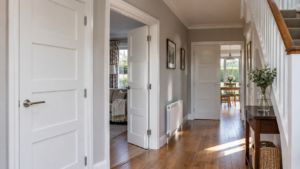
If you want the same finish along a landing, start with the face pattern, colour and hardware. Ask whether the appearance you like comes in more than one construction. You may be able to keep the same look while spending differently on the bedroom and linen cupboard.
Read the core and finish as separate decisions
An oak finish describes the visible material or appearance. A solid core description refers to the construction inside. Write both on your shortlist. If you ask for an oak door alone, you still have questions to settle about the inside, the edge and how the product arrives.
Likewise, you may see a supplier list a solid option beside a glazed one. In that context, ask whether solid describes a leaf without a glass panel or the core construction. Have the supplier confirm the exact product code so the description on the order has one meaning.
If you like timber grain but prefer a pale look, compare the supplier’s white oak internal door finishes against a sample of your floor. View the two together in the hallway. A dark carpet can change which sample looks right to you.
Compare three choices against the same brief
| Option | Where to start considering it | Question to put to the supplier |
|---|---|---|
| Hollow core | A low-priority opening where appearance and price drive the choice | What can be trimmed and where can hardware be fitted? |
| Solid core | A frequently used room where closing feel or privacy matters | What core, hinges and frame are proposed? |
| Solid timber | An opening where you specifically want that timber construction | What exactly is solid timber and what care does the finish need? |
Use one brief for all three comparisons. For a bedroom, it might say that the existing frame is painted, the hall has new carpet and you want a plain door with a satin lever. Send the same description each time so you can see which quote actually fits it.
The labels narrow your shopping list. Your room priorities tell you where each option belongs.
Spend first on the doors you deliberately close
Do a quick walk around your house at the time of day it is busiest. Notice which doors people close, which ones stay propped open and which are missing altogether. The result is a better guide to spending than a ranking based on the rooms visitors see first.
Give each opening one job. A home office door might need to keep conversations private. A family bathroom might need a reliable privacy latch. A hall cupboard might need a face that blends into a row of panelled doors. Those are three different purchase briefs.
Bedrooms and the home office
Imagine someone trying to sleep upstairs while two people talk on the landing. If that describes your home, start with the bedroom that catches the most activity. Compare the way the existing door meets the frame and ask whether sound control is part of the proposed work.
For a home office, think about where your desk sits. A desk facing the landing door may put your voice close to it during calls. Before investing, move the desk or test a call with somebody outside. If the conversation is still easily understood, tell the fitter what you heard and where.
For conversations that need privacy, ask for a specified acoustic installation. In its 2026 product brochure, Deanta reports test results for complete sealed door configurations. Use the full configuration as the reference when discussing whether a test is relevant to your project.
Bathrooms, utility rooms and busy landings
In a bathroom, list visual privacy, handle operation and the door’s relationship to ventilation as separate questions. Try the privacy lock with the handle you want. Ask who confirms that the selected finish suits the room and who will follow the supplier’s care instructions during fitting.
At the utility room, listen while appliances are running. Stand in the kitchen, then in the room where the noise bothers you. If you still hear it when the utility door is closed, describe the sound and where it seems loudest. You might be asking about vibration as well as airborne sound.
A landing has another consideration. Close a bedroom door while someone opens the bathroom door. See whether the swings compete, especially where people wait on the landing. Add any conflict to the survey notes before discussing a heavier version of the same leaf.
Cupboards and doors usually left open
Keep an existing cupboard door on your shortlist if it moves comfortably, closes reliably and matches the look you want. Ask for a separate repainting or hardware option if its main problem is appearance. That gives you a comparison with the price of replacing the leaf.
For a dark entrance hall, look at how you use the living room door. If you leave it open for borrowed light, compare an appropriately specified glazed style with the solid-faced option. The glazed internal doors guide offers ideas for where that choice makes sense.
Once you know which openings need the most attention, work out what kind of sound improvement you are actually asking for.
What to expect from a door upgrade for sound
A useful goal sounds like something you can check: less intelligible speech from the study when you stand on the landing, or a quieter bedroom while the television is on downstairs. Those goals let you discuss a test and decide which doorway matters first.
Think through the whole path. There is the surface of the leaf, the edges around it and the opening at the floor. There may also be a separate route through the wall or ventilation. A change to one route can be a good investment while another continues to carry noise.
Ask what the quoted acoustic figure covers
An acoustic figure should come with a description of what was tested. Ask whether it covers the leaf or the doorset, including its frame and seals. The Lorient guide explains how assemblies and sealing configurations are tested.
For a quote that gives a rating, ask for the written test reference and matching configuration. Compare the glazing, frame, perimeter treatment and bottom seal with what the installer will supply. If a component differs, ask what evidence applies to the proposed combination.
Be specific about the sound you want to reduce. Try saying that ordinary speech from a call carries down the hall, or that a spin cycle interferes with conversation. A fitter can ask useful follow-up questions when there is a real example and a location to check.
Record the condition of the current opening
Look at the door from both sides in daylight. Make a note if one edge has a visibly uneven gap, if the leaf moves after it latches, or if light is obvious under one corner. Treat your notes as observations for the survey. Leave the product specification to the measured assessment.
Try the same listening spot with the door open and closed. If you do a before-and-after check, use the same speaker location and the same volume. That gives your household a meaningful comparison even when you have no instruments or formal test.
For a room with planned airflow, flag any proposed change to the bottom gap or seals. The Department of Housing sets out dwelling ventilation guidance in Technical Guidance Document F. Have the relevant professional confirm how the room is meant to receive transfer air before changing the detail.
You can now talk about the full opening rather than just the leaf. That is where the survey becomes worth doing.
Check the frame, swing and floor before ordering
If a door rubs, swings on its own or needs a lift at the handle to catch, record it before the fitter visits. A new leaf will be quoted against the opening it has to occupy. Ask whether the current difficulty calls for adjustment, different hardware or a change to the frame.
Check for trim you want to keep. If there is period architrave or a skirting profile you cannot easily match, point it out. Ask how much of the surrounding finish the fitter plans to touch. Agree who will make good any exposed paint or plaster.
Check whether the frame is staying
Give each door one of three statuses: frame likely retained, frame replacement requested, or survey needed. A photo of the frame helps explain your preference. The fitter should confirm its condition and dimensions on site before making a final decision.
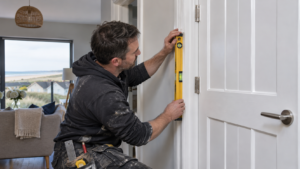
Have the hardware listed alongside the door model. Ask who supplies the hinge set and latch and who confirms suitability for the leaf. Agree whether existing screw holes, hinge recesses and the strike position can be reused or need work. The internal door installation guide explains the fitting scope in more detail.
Use the manufacturer’s trim limit
Tell the supplier the opening has been surveyed and ask how the selected model can be adjusted. A visible timber edge or lipping is only part of the picture. The published instructions for the model set out what the maker allows.
For a tight opening, ask for a better-sized model, or request a separate line for work to the frame. Compare those paths with the first choice in writing. Keep the proposed order on hold while you are still deciding how a specific mismatch will be resolved.
Bring future floor heights into the conversation
If your hall will get timber, tile or carpet, tell the fitter whether the existing finish stays. Show the flooring specification and any transition strip you plan to use. Ask which trade is responsible for confirming the final level and how that information reaches the person hanging the door.
Try opening the old door across its whole path. Note a rug, a raised edge or a spot where it already catches. Take a photo from low down to show the meeting point between rooms. This is especially useful when two rooms are getting different floor finishes.
The measured opening gives you the inputs for a sensible quote. Before comparing prices, separate everyday door upgrades from any specialist requirement.
Keep fire performance and everyday construction separate
If a doorway forms part of a fire-safety design, start with the specification for that opening. Ask the person responsible for the design what evidence and installation details apply. The Department of Housing publishes fire-safety guidance for dwelling houses in Technical Guidance Document B, Volume 2.
Before replacing a door with labels or unfamiliar seals, photograph the edge and frame and keep any product paperwork. Tell the fitter if the opening is part of a conversion or leads to an attached garage. An opening’s role is more useful to the discussion than its appearance.
Ask for the documentation to match the quote
A quote for a specified fire door installation should give you enough detail to match the proposed components to the design and supporting documentation. Ask who will confirm the leaf, frame, hardware, seals and any permitted glazing. Keep that confirmation with your project file.
If your project needs both acoustic and fire performance, tell the supplier about both requirements at the same time. Ask for evidence covering the proposed arrangement and clarification of any change from the specified design before you pay a deposit.
Ordinary room doors can then be assessed on comfort, finish and cost, with any special openings clearly set apart in the budget.
Compare the extra cost per fitted opening
Start with one doorway and ask for two installed options against the same scope. For example, request a hollow core and a solid core option with similar-looking finishes, both priced for the same bedroom. Ask the supplier to put all unavoidable work on both sides of the comparison.
A useful worksheet has columns for leaf, frame work, hardware, fitting, finish and removal. Add the totals only after you have checked who does each item. The internal door fitting cost guide is useful for recognising the different ways work can be packaged.
Price the room you have today
For a retained frame, include any work needed to prepare the hinge positions and close the latch properly. Ask how much of the original paint will be disturbed. With a replacement frame, ask whether both sides of the opening receive new architrave and what making good is covered.
For a primed option, ask who applies the final paint and whether the door has to be removed again for that work. With a prefinished leaf, ask what happens to a trimmed edge. Ask who supplies care instructions at handover and which items you should keep on file.
Decide what to upgrade now
Make a short list of rooms where you can name the difference you want. Put the early sleeper’s bedroom, study or noisy utility opening at the top if those are your priorities. Put a door lower when the current one closes properly and changing it would be mostly cosmetic.
If the same profile matters across several rooms, check whether the door style and hardware are available before splitting the order. Ask how a future batch might differ and what identifying information to keep. A product code and handle finish are more helpful than a phone photograph alone.
You can compare that shortlist against East Coast Doors Ireland’s guide to supply and fit internal door packages before asking for a room-by-room quote. Request clear pricing for upgrades and for any standard options you want to retain.
A good price comparison leaves you with a small set of choices. The last step is turning those choices into a specification you can approve.
Build a door brief the fitter can work from
Walk from the entrance to the upper floor and give each opening a number. Write the room, the direction it opens, the existing problem and your preferred finish. Add one photo from each side when the surrounding trim, floor transition or nearby furniture matters.
Mark an opening that is hard to reach or has stairs close to the swing. If a large glazed leaf or several heavy doors are proposed, discuss how the installer will get them into the house and where they can be handled on the day.
Ask the fitter to confirm the decisions in order
Start with what stays: frame, architrave, skirting and any handles you want reused. Then confirm the door model and intended use. Finish with who covers painting, touch-ups, removal and return visits. Getting those decisions in writing makes fitting day easier to manage.
Check the dimensions against the agreed floor plan, including any upcoming covering. Ask the fitter to note whether an opening can use the selected standard size within the maker’s limits. Keep the drawing or schedule with the revised quote if any dimensions change.
Once the work is finished, use each opening as you would in the evening. Try the handle, latch and privacy lock, check the swing with the furniture in place and note any issue by opening number. Ask for the product documents and care information before putting the paperwork away.
With that brief in hand, the remaining buying questions become much easier to answer.
Compare two sample doors in the same part of the house
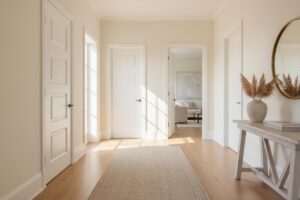
If the project includes several doors, take the time to judge the look and feel separately. Use the hall as your reference point if most of the doors open onto it. Put your paint, floor and handle samples beside the face sample and walk away. Turn around and look from the end of the hall.
A door that looks pale in a bright display room might look warmer under the light you use at home. Check again after dark. If the door will be beside another finish, view both samples at the same time, with the lights you normally switch on.
Try comparing the two options without looking at the price first. Identify the feature you can actually see or feel. Then read the product descriptions. That sequence helps you decide which difference you would pay for and which one only looks important on the quote.
Work out how a finish fits your decorating plans
If you expect to paint the landing next year, decide whether you want a door finish you can already live with. For a white design, compare factory-finished white internal doors with the painted finish you want for the frames and architraves.
If the colour needs to match a particular paint, ask about white primed door options and put final decoration on the quote. Give the painter and fitter the same sequence so both know when painting and touch-ups are supposed to happen.
For an oak finish, look at an open door as well as a closed one. The edge will be visible when the door stands open. Compare the face and edge of a sample from the prefinished oak door range with the trim you plan to keep.
Think through the result from both sides
A hall is only one view. Look at the door from the bedroom, study or sitting room as well. A handle you like in a bright hall can look more prominent against a dark wall. If you are mixing finishes, choose which side of the opening sets the visual priority.
Use the East Coast Doors installation gallery to identify details you like. Save examples for the frame profile, face pattern or glass. Put a note beside each screenshot so the fitter knows which detail you are pointing out.
Think about how several doors will look together with one open. Photograph the view at a turn in the stairs or from the kitchen table. If a dark door dominates that angle, try the finish in one room before committing to the entire landing.
Check operation with the person who will use it most
A door can feel reassuringly substantial to you and still be awkward for someone else to move. Let the person who uses the room most try the handle and closing action. If a member of the household has difficulty with grip or reach, tell the fitter which movement is awkward.
Take that observation into the survey. Ask how the selected leaf, handle and latch will work together in that opening. Check how the door swings with a laundry basket, chair or walking aid in the route. Walk the whole path with the door at its normal resting position.
Record your final preference as a sentence. For instance, you might want the same white panel on three bedroom doors, a quiet latch in the first bedroom and a clear view into the sitting room. Bring that brief to the door measuring visit to see which details can be confirmed before ordering.
Compare one completed opening with the rest of the plan
If you are unsure whether the upgrade is worth repeating, ask whether the project can be phased. Choose an opening that represents the way you expect to use the others. A frequently used bedroom is a better trial for your landing than a cupboard with a different frame and latch.
Set out what you want to assess before the work starts. Try the closing action after fitting, compare the finish with your trim and see whether the room feels more private in normal use. If sound performance is a specified requirement, use the documentation and checks agreed for that opening.
Keep any observations tied to the actual assembly and room. Your first result may help you decide what to repeat upstairs, while a glazed sitting room door or a differently sized utility opening may still need its own decision.
You should now have a preferred look, a shortlist of rooms and a practical test for each upgrade. The questions below will help you check the last details before committing.
Frequently asked questions
Are solid core doors worth it for every room?
Start with bedrooms, offices and other rooms where closing the door matters. A cupboard or rarely closed room may justify a simpler option. Compare the installed price and the job each opening needs to do.
Can I fit a solid core door in my old frame?
Ask the fitter to assess the frame condition, opening size, hinge arrangement and finished floor before ordering. A written quote should identify which frames stay and which need work, along with the hardware proposed for each.
Will a solid core door make a room soundproof?
Ask for a tested assembly when you need a stated sound rating. Ask which seals were included in the test. Describe the sounds and where you hear them so the specification addresses your actual problem.
Is an oak veneer door solid core?
It can be. The veneer describes the facing, so ask for the manufacturer’s construction sheet. Ask for a matching product code before ordering.
What do I send for a useful quote?
Send your area, door count, preferred finishes and a few photographs of the frames and floor transitions. Flag any doors that stick, any flooring you plan to replace and any opening with a known specialist requirement.
Use those answers to separate the doors you want from the doors you need to check.
Make the upgrade where you will notice it
Solid core doors are worth the upgrade where you will use the difference: a bedroom you close at night, an office you need for calls, or the door your family opens every morning. Give each opening a job and compare the total fitted scope against that job.
Bring your shortlist and a few frame photos to East Coast Doors Ireland. Start with the room you most want to improve and get it measured so you can move forward with a door you will enjoy using every day.